SpaceX’s entry into the public stock market is one of the most anticipated events in recent financial history. Beyond the headlines about rocket launches and Mars colonies, the company’s official IPO filing (Form S-1) tells a much more complex story one that is deeply tied to the personal decisions, business dealings, and public persona of a single man: Elon Musk.This filing is unlike anything Wall Street has seen before. It doesn’t just describe a rocket company going public. It maps out an entire ecosystem of interconnected businesses, shared resources, mutual investments, and potential conflicts of interest all orbiting around Musk himself.
SpaceX’s Web of Business Relationships with Other Musk Companies
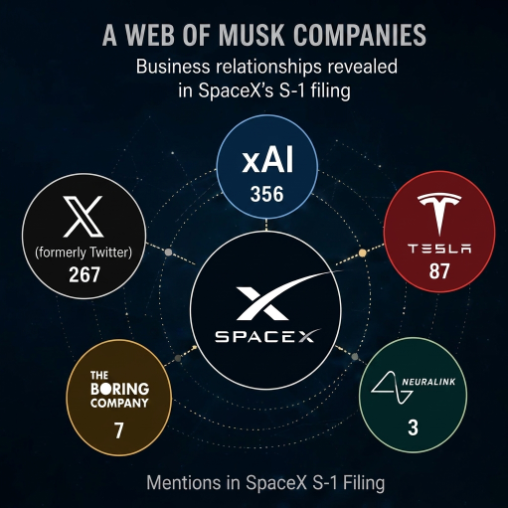
One of the most eye-opening parts of the SpaceX S-1 is just how much business SpaceX does with other companies that Musk owns or leads. A quick word search through the 330-page document tells you a lot:
- xAI is mentioned 356 times
- X (formerly Twitter) appears 267 times
- Tesla shows up 87 times
- The Boring Company is referenced 7 times
- Neuralink is mentioned 3 times
These aren’t just casual name-drops. They reflect real financial transactions and shared business activities happening between companies that all answer to one person.
Tesla and SpaceX: More Connected Than You Think
Tesla’s relationship with SpaceX goes well beyond sharing the same CEO. According to the S-1 filing, Tesla currently holds nearly 19 million shares of SpaceX’s Class A common stock a stake of under 1% of total shares outstanding. This came about after Musk’s AI company, xAI, merged with SpaceX in February, and Tesla’s existing stake in xAI was converted into SpaceX shares.
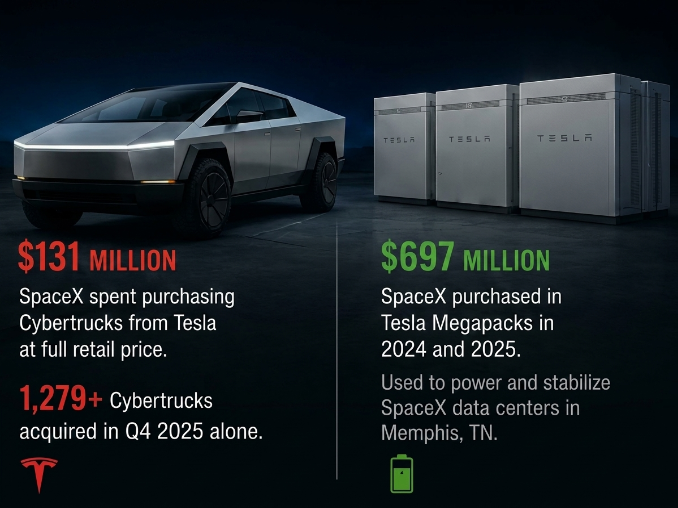
But the financial ties don’t stop at stock ownership. SpaceX spent $131 million purchasing Cybertrucks directly from Tesla at full retail price. Reports suggest SpaceX acquired over 1,279 Cybertrucks in the last quarter of 2025 alone, and the total number is likely even higher. Industry observers have noted that without these internal purchases, Cybertruck sales figures would have declined year over year.
On the energy side, SpaceX purchased $697 million worth of Tesla Megapacks the company’s large-scale battery storage units in 2024 and 2025. These batteries are being used to power and stabilize SpaceX’s Colossus I and II data centers in Memphis, Tennessee during periods of high energy demand
The Boring Company: A Minor but Notable Partner
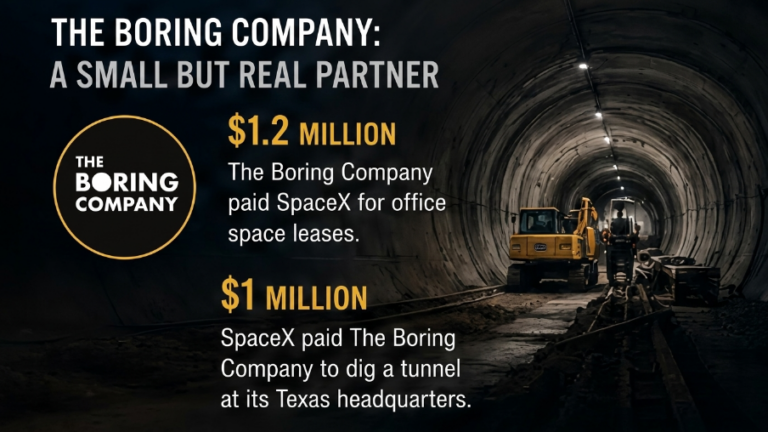
Compared to the Tesla relationship, SpaceX’s dealings with The Boring Company are much smaller in scale. The tunneling startup has paid approximately $1.2 million in office space leases to SpaceX. In return, SpaceX paid The Boring Company around $1 million to dig a tunnel at its headquarters in Bastrop, Texas. It’s a modest arrangement but it still reflects the pattern of Musk’s companies doing business with each other.
The xAI Merger and Its Financial Impact
Perhaps the biggest story in the filing is the merger between SpaceX and xAI Musk’s artificial intelligence company that also owns X (formerly Twitter). This tie-up pushed SpaceX’s valuation to a staggering $1.25 trillion earlier in 2025.
But the merger came at a significant cost. SpaceX directed roughly 60% of its total capital spending in 2025 toward xAI approximately $20 billion. That’s a massive internal investment in an AI venture that, according to the filing, saw its revenue grow by only 22% year over year while still losing billions of dollars.
For investors buying into the SpaceX IPO, this raises a natural question: are they funding space exploration, or are they subsidizing a struggling AI company?
Elon Musk: The Asset That Is Also a Liability
Every company going public must disclose its risk factors to potential investors. For most companies, these include things like market competition, supply chain issues, or regulatory hurdles. SpaceX’s list includes all of those but it also includes something no other S-1 filing has ever featured so prominently: its own CEO.
The filing openly acknowledges that SpaceX is “highly dependent on the continued services of Mr. Musk.” His leadership skills, technical knowledge, and overall vision are described as central to the company’s ability to grow and succeed.
At the same time, the document is honest about the complications this creates:
- Musk simultaneously leads Tesla (as Technoking and CEO), SpaceX, xAI/X, Neuralink, and The Boring Company
- He previously served as Senior Advisor to the President of the United States
- His divided attention means SpaceX does not always have his full focus
The filing also warns that Musk’s other ventures could end up competing with SpaceX for talent, funding, and scarce resources like AI chips and computer memory. And critically, the filing acknowledges that Musk is not legally restricted from pursuing business opportunities that could directly compete with SpaceX.
The Reputation Risk: A Double-Edged Sword
SpaceX’s S-1 takes the unusual step of addressing Musk’s public image as a business risk. The filing notes that both SpaceX and Musk receive an extraordinary amount of media attention and that his actions, statements, and public behavior could either help or hurt the company, regardless of whether they have anything to do with SpaceX directly.In an era where executive conduct is under constant social media scrutiny, this kind of disclosure is significant. Musk is simultaneously one of the most admired and most polarizing figures in the global business world. His presence can attract investors and customers but his controversies can just as easily drive them away.
Conflicts of Interest: A Risk the Filing Doesn’t Hide
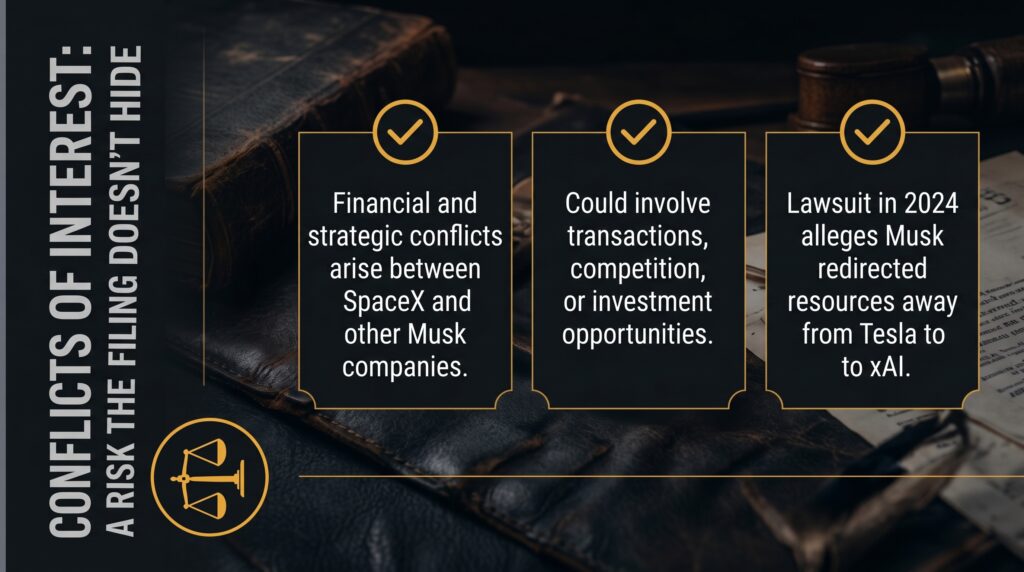
To its credit, SpaceX does not sugarcoat the conflict-of-interest problem. The filing explicitly states that financial and strategic conflicts could arise between SpaceX and the network of Musk-affiliated companies. These conflicts might involve business transactions, competitive activities, or investment opportunities.
This concern is not just theoretical. In 2024, several Tesla shareholders filed a lawsuit against Musk, claiming he was deliberately redirecting talent and resources away from Tesla and toward xAI. That lawsuit is still ongoing.
If one of Musk’s companies benefits at another’s expense, the question becomes: which company bears the cost? With SpaceX now public, those costs will matter to a whole new group of investors.
What This Means for Investors
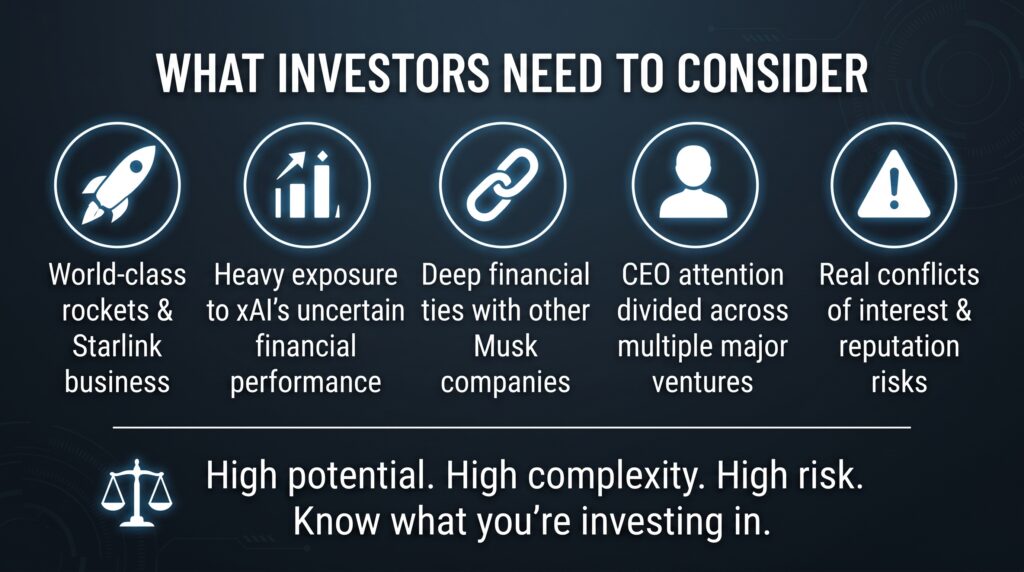
SpaceX is entering the public market at an extraordinary valuation. Its core business — building rockets and launching satellites through its Starlink division is genuinely impressive and financially significant. But the IPO package investors are buying into comes bundled with:
- Heavy exposure to xAI’s uncertain financial performance
- Deep financial entanglement with other Musk companies
- A CEO whose attention is divided across multiple major ventures
- Real and openly acknowledged conflicts of interest
- A reputational risk tied to one individual’s public behavior
For those comfortable with that level of complexity and willing to bet on Musk’s long-term vision the SpaceX IPO could represent a once-in-a-generation investment. For others, the very things that make SpaceX exciting may be exactly the things that give them pause.
Final Thoughts: An IPO That Rewrites the Rules
SpaceX’s public offering is historic on multiple levels. It’s not just a company going public it’s an entire universe of interrelated businesses, ambitions, and risks being offered to everyday investors for the first time. The S-1 filing is unusually candid about the role Elon Musk plays in all of it: essential, irreplaceable, and potentially dangerous to the company’s future all at once.
Whether that makes SpaceX the investment opportunity of the decade or a cautionary tale in the making depends entirely on how much you believe in the man at the center of it all.