
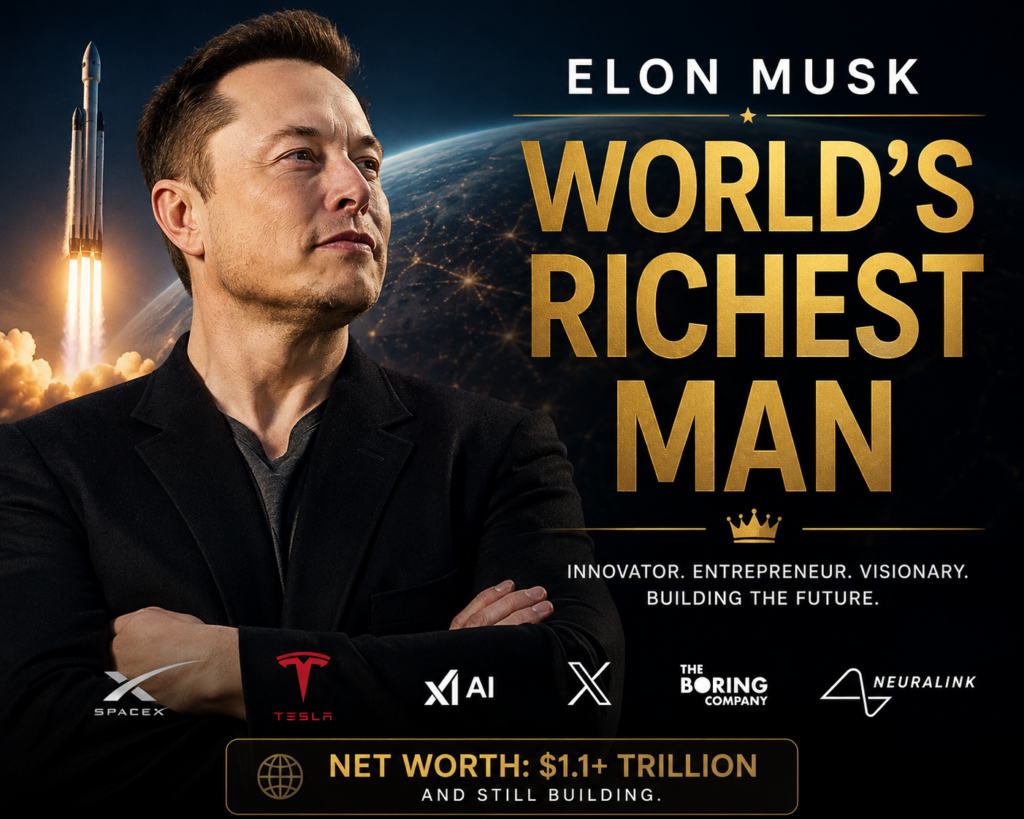
On June 12, 2026, Elon Musk became the first person in recorded history to be worth more than a trillion dollars. Here’s how a $180 million PayPal payout snowballed into a $1.1 trillion empire visualized in six charts. For more than a century, the ceiling of personal wealth was measured in billions. That ceiling cracked at 11:46 a.m. Eastern Time on a Friday in June 2026, when SpaceX shares ticker symbol SPCX opened for trading on the Nasdaq at just above $150. By the closing bell, the stock had jumped 19% to $160.95, valuing the rocket-and-satellite company at more than $2 trillion. Musk’s roughly 38% stake alone was suddenly worth around $800 billion, and combined with his Tesla, xAI, and X holdings, his net worth rocketed past the $1 trillion mark.
Forbes pegs his fortune at closer to $1.2 trillion. Bloomberg puts it at $1.11 trillion. Either way, the math is staggering: Musk is now worth more than the next three richest people on Earth combined. Below, we trace the rise from a near-bankrupt rocket start-up in 2008 to history’s first trillionaire in charts.
The Wealth Curve: From $180 Million to $1.1 Trillion in 24 Years
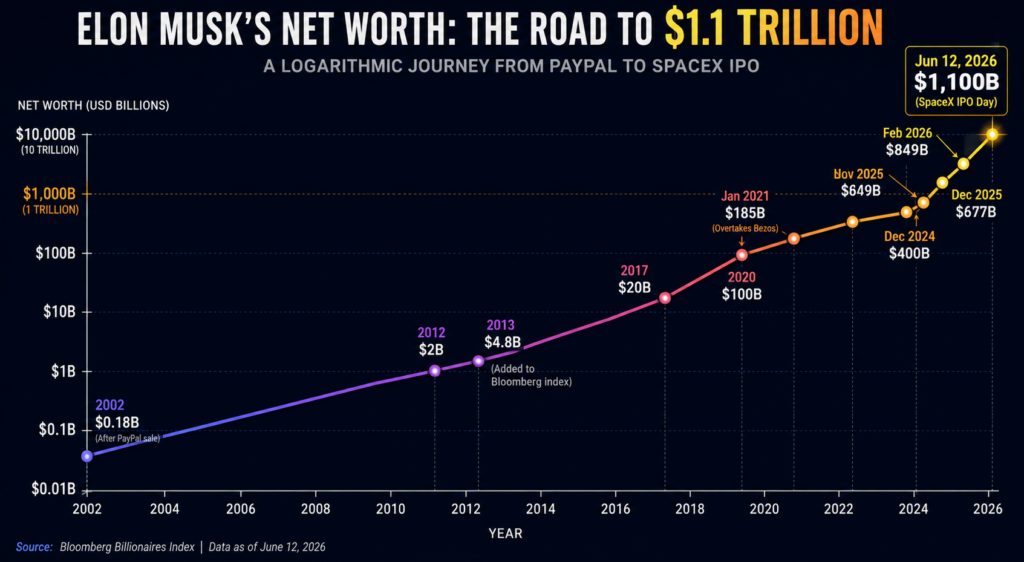
Musk walked away from eBay’s acquisition of PayPal in 2002 with roughly $180 million after taxes, according to Britannica. He poured almost all of it into two near-suicidal bets: a private rocket company called SpaceX and an electric car startup called Tesla. Both nearly collapsed in 2008. SpaceX’s first three Falcon 1 launches failed. Tesla burned through cash. Musk was reportedly sleeping on friends’ couches.
The fourth Falcon launch worked. The Tesla Model S went on to define a category. By 2013, when Bloomberg first added him to its Billionaires Index, he was worth $4.8 billion. By 2020, $100 billion. By January 2021, he overtook Jeff Bezos to become the world’s richest person a title he has held, with one brief interruption from Larry Ellison, almost continuously ever since.
The final push to $1 trillion didn’t come from selling anything. It came from repricing what he already owned.
Where the Trillion Comes From: An Empire in Four Parts
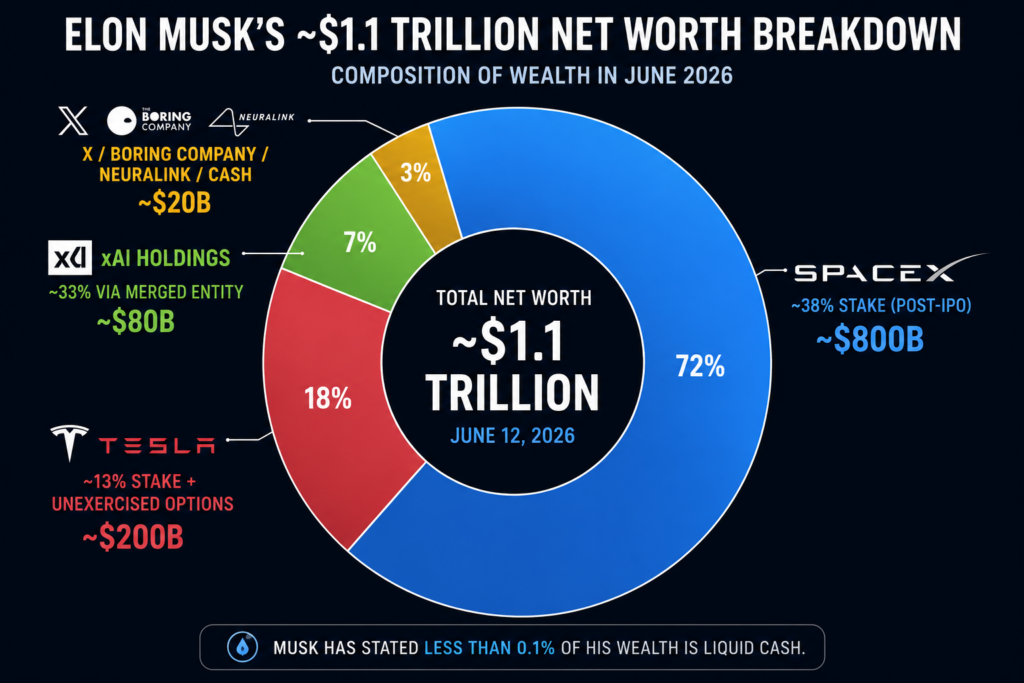
Musk himself has repeatedly pointed out that his “net worth” is almost entirely paper ownership stakes in companies he founded or runs, not cash in a bank account. In a February 2026 post on X, he said less than 0.1% of his fortune is liquid. The breakdown matters because it explains the volatility. Tesla shares can swing 5% in a single session, moving Musk’s net worth by $30 to $50 billion in a day. SpaceX, now publicly traded as SPCX, will likely behave similarly especially given concerns flagged in the IPO prospectus, including a reported $4.3 billion net loss in the first quarter of 2026.
Critically, Elon Musk retains roughly 85% of SpaceX’s shareholder voting power through dual-class shares, meaning Wall Street can value his company but cannot control it.
Bigger Than the Next Three Combined: The Billionaire Leaderboard
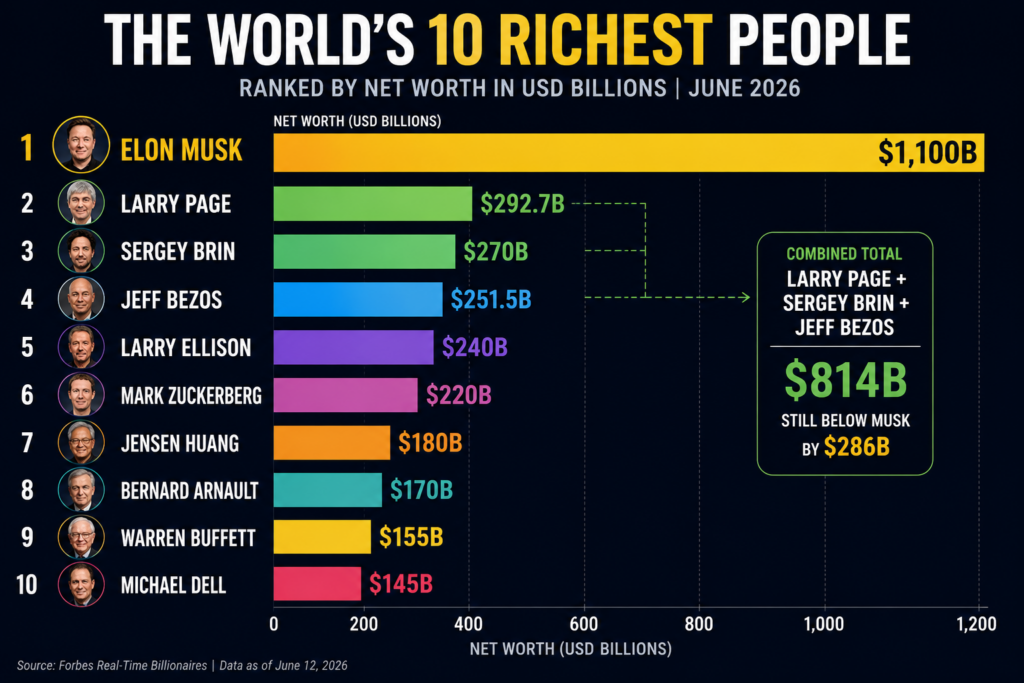
According to Forbes’ Real-Time Billionaires list, Musk’s fortune is nearly four times the size of the next-largest, Google co-founder Larry Page. It exceeds the combined net worth of Page, Sergey Brin, and Jeff Bezos. The top 10 wealthiest people on Earth collectively hold around $3 trillion and Musk alone accounts for more than a third of that total. Nine of the top 10 are American, and eight built their fortunes in technology. The generative AI wave lifted the valuations of chip designer Nvidia, enterprise software giant Oracle, and PC maker Dell to heights that pushed their founders into the top ten but even those gains left them separated from Musk by hundreds of billions of dollars.
The Largest IPO in Stock Market History
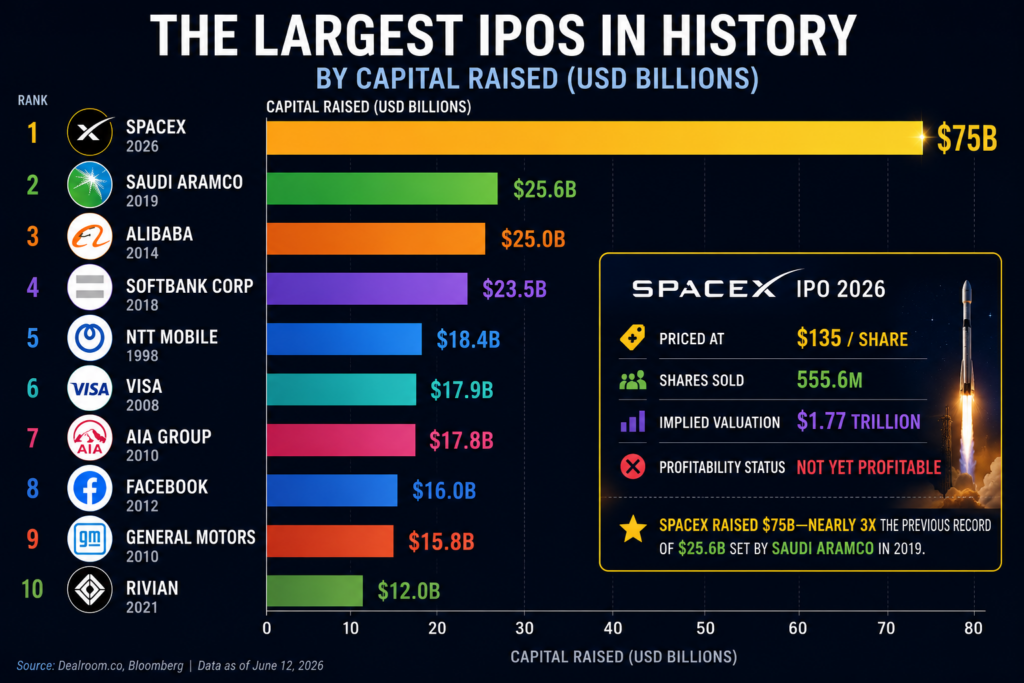
SpaceX priced its IPO at $135 per share and sold 555.6 million shares, raising $75 billion. That is nearly three times the previous record Saudi Aramco’s $25.6 billion listing in 2019 and the single largest equity capital raise in market history. The valuation it implied at pricing ($1.77 trillion) put SpaceX between Tesla and Apple. By the end of its first trading day, its market cap had ballooned past $2.1 trillion, putting it within striking distance of Amazon. It is also, notably, not yet profitable.
Wealth as a Share of the U.S. Economy: Bigger Than Rockefeller
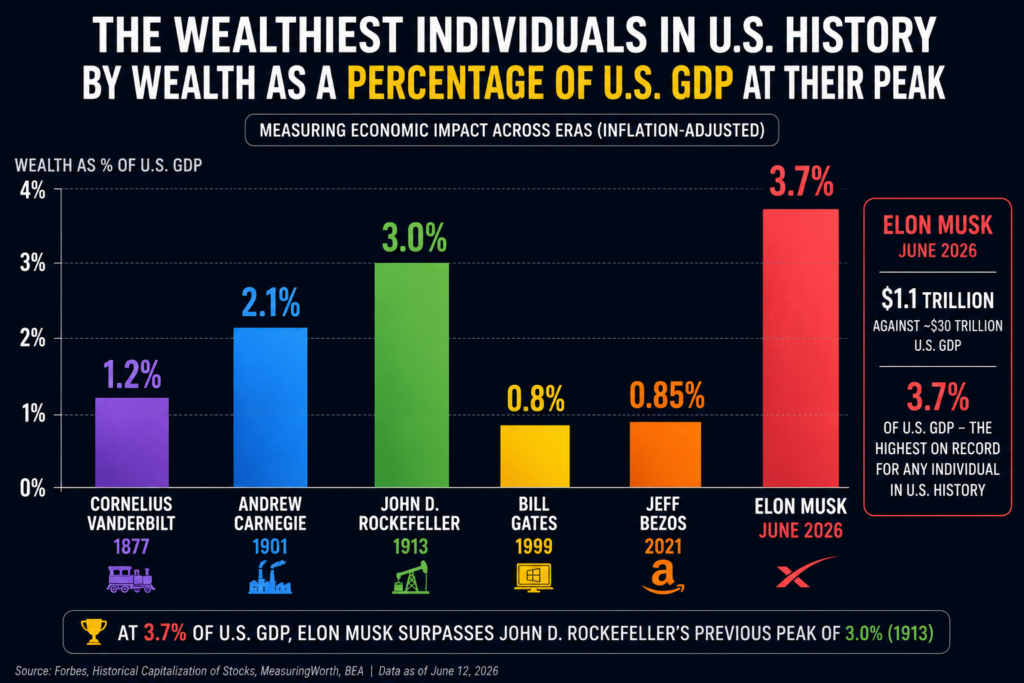
For more than a century, John D. Rockefeller’s Standard Oil fortune was the benchmark for the wealthiest individual relative to the size of the U.S. economy. At his 1913 peak, his net worth amounted to roughly 3% of U.S. GDP. Musk’s $1.1 trillion against a current U.S. GDP of approximately $30 trillion works out to about 3.7%. In other words: by the most meaningful inflation-adjusted measure, Musk is now the wealthiest individual in U.S. history full stop. Rockefeller built Standard Oil over four decades, in one industry, by ruthlessly consolidating a single commodity. Musk built his fortune in 24 years, across rockets, electric cars, satellites, AI, social media, and tunneling starting from $180 million.
Day One on the Nasdaq: How the Stock Behaved
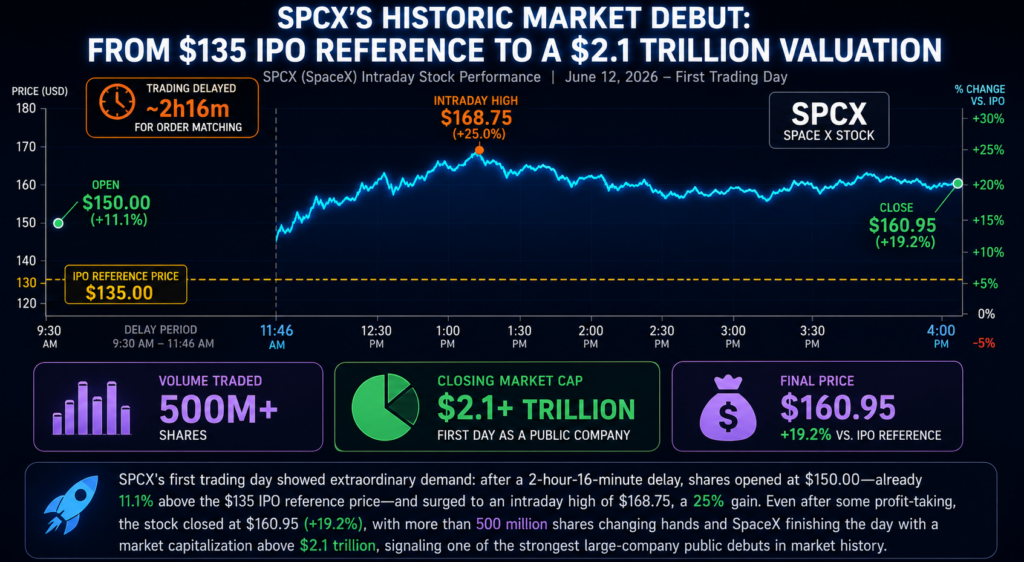
Trading didn’t begin on schedule. The volume of buy orders was so heavy that the Nasdaq’s order-matching system took nearly two and a half hours to find a clearing price. When SPCX finally opened at $150, $11.4 billion changed hands in the first few minutes. By session’s end, more than 500 million shares had traded a dollar volume that exceeded the day’s combined trading in the QQQ and SPY ETFs.
Not everyone was sold. Morningstar published a discounted-cash-flow valuation that pegged SpaceX’s “fair value” at $780 billion less than half of the IPO price. CFRA issued a sell rating within hours of the open. Other space stocks fell sharply as capital rotated into the new mega-cap: Firefly Aerospace dropped 18%, Virgin Galactic plunged 34%.
But for now, none of that matters to the math at the top of this article. The market has spoken. There is, for the first time ever, a trillionaire.
What Happens Next?
Three things are worth watching:
Lock-up dynamics. Musk himself cannot sell his SpaceX shares for at least a year. Founder lock-ups longer than the standard six months usually signal a desire for the market to price the company on fundamentals rather than insider-selling pressure.
The AI pivot. SpaceX is no longer just a rocket company. It has absorbed Musk’s xAI, and the IPO prospectus describes plans for “orbital AI compute infrastructure” data centers in space, powered by Starlink grade satellite networks. If that thesis works, SpaceX could be repriced as an AI infrastructure company, not a launch provider.
Tesla’s $1 trillion pay package. Approved by Tesla shareholders in late 2025, Musk’s performance-based stock compensation could add hundreds of billions to his net worth over the next decade entirely separate from SpaceX. For now, though, a single fact stands: as of Friday, June 12, 2026, the first trillionaire in human history is a 54 year old engineer who arrived in the United States with a Canadian passport and a $2,000 student budget. The next ceiling, whatever it is, has not yet been named.
Frequently Asked Questions
1: Who is the world’s first trillionaire? Elon Musk became the world’s first trillionaire on June 12, 2026, the day SpaceX began trading publicly on the Nasdaq under the ticker SPCX.
2: How much is Elon Musk worth right now? Bloomberg estimates his net worth at approximately $1.11 trillion. Forbes puts it closer to $1.2 trillion. Because the bulk of it is tied up in Tesla and SpaceX stock, the number shifts from one day to the next as those shares move.
3: How did Elon Musk become a trillionaire? The trillion-dollar threshold was crossed when SpaceX’s IPO repriced his roughly 38% private stake at public-market values. SpaceX closed its first trading day at a market cap above $2.1 trillion, making Musk’s stake alone worth roughly $800 billion. Combined with his Tesla, xAI, and X holdings, his total surpassed $1 trillion.
4: What companies does Elon Musk own? His major holdings are SpaceX (~38%), Tesla (~13% plus unexercised stock options), xAI Holdings (~33% via merger), X (formerly Twitter), The Boring Company, and Neuralink.
5: Is Elon Musk richer than Rockefeller was? Yes by the most common inflation-adjusted measure (wealth as a percentage of U.S. GDP), Musk’s fortune at roughly 3.7% of GDP slightly exceeds John D. Rockefeller’s 1913 peak of about 3%.